Introducing "Seek These Things"
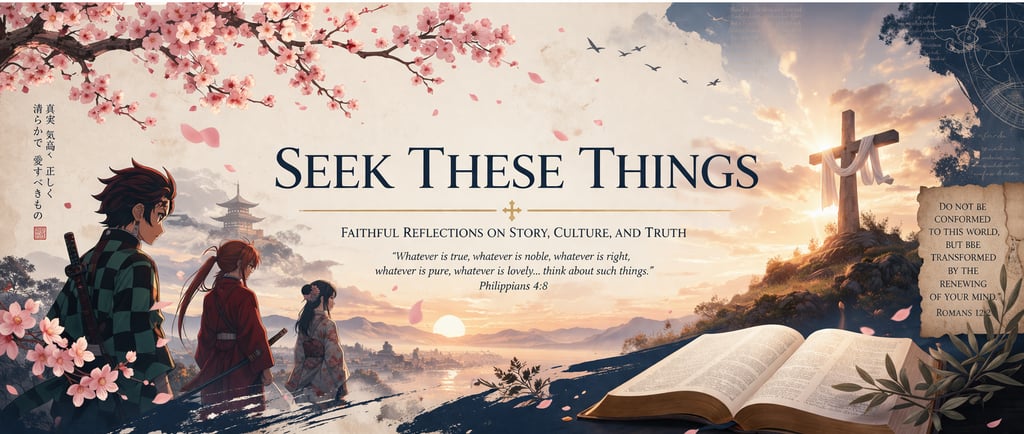
This blog takes its name from Philippians 4:8: "Finally brothers, whatever is true, whatever is honorable, whatever is just, whatever is pure, whatever is lovely, whatever is commendable... seek after these things." That is the goal. Not to ignore what is false or harmful, but to learn how to recognize what is true, even when it appears in unexpected places
Skylar Bennet
Christian culture, especially in the United States often swings between two extremes in the way we approach media.
On one side, discernment is abandoned entirely, and no thought is given to how the media we consume is shaping us.
On the other, anything that is perceived as being “of the world” is treated with suspicion. This is especially true when it comes from cultures which are not predominantly Christian. Entire mediums, genres, artistic movements, or traditions are dismissed outright, not because they’ve been examined, but because they’re unfamiliar.
In some cases, that suspicion has been stronger toward stories that come from outside familiar cultural frameworks. When something is harder to interpret, it’s often easier to treat it as questionable than to take the time to understand it.
A personal Note
I grew up witnessing this tension firsthand.
I grew up in the late 90s and early 2000s, I remember hearing the debates surrounding Pokémon and Harry Potter when both were at the height of their popularity, about whether they were harmless, questionable, or outright banned.
I wasn’t personally restricted in what I watched or read (for religious reasons anyway).
I grew up having the first two Harry Potter books read to me by my mother. Some of my first favorite shows were Sailor Moon and Pokémon. I remember renting Kiki’s Delivery Service and Castle in the Sky from Blockbuster back when video stores were a thing. It certainly wasn’t that I had no boundaries, but the ones I had, were based on age-appropriateness, not a lack of discernment.
but I knew plenty of people who were restricted from things that I loved, and when I asked why, they said they didn’t know, or that their parents’ said it was “demonic” but that they weren’t sure what that meant.
Even when something wasn’t explicitly off limits, if it was one of the books/shows/movies, that was being debated, there was often uncertainty around it.
At the same time, I saw the opposite approach, engagement with little to no thought or discernment at all; and both these approaches stuck with me.
What I didn’t have then, that I do have now, is a framework for thoughtfully engaging with the media I consume.
A Different Approach
That’s why I’m taking this publication down a different path than what we usually see in these conversations, not because every story is good or harmless—but because people, wherever they are, continue to wrestle with the same questions:
What does it mean to live well?
What do we do with guilt?
Can people change?
What is worth sacrificing for?
Often there is truth reflected in unexpected places, and when we approach stories with a spirit of discernment—not fear—we don’t just protect ourselves.
We learn to see more clearly.
And in doing so, even entertainment can become something that shapes us.
Why This Matters
Stories are never neutral.
They shape how we think about:
good and evil
justice and mercy
identity and purpose
If we don’t engage them thoughtfully, they will still shape us—just without our awareness.
But when we do engage them thoughtfully—when we bring discernment, attention, and a grounding in truth—we begin to recognize something surprising:
Truth shows up more often than we expect.
Why Anime?
Anime is one of the clearest places where this tension shows up.
For some Christians, it’s consumed without much thought. For others, it’s dismissed outright—often because it comes from a cultural context that feels unfamiliar or difficult to interpret.
But anime is not a monolith.
Like any storytelling medium, it contains both shallow and profound stories. Some distort truth. Others reflect it—sometimes with surprising clarity.
We will spend a lot of time here—not because anime is uniquely important, but because it is frequently overlooked.
What You'll Find Here
You’ll find essays that read stories alongside Scripture.
You’ll find reflections on themes like redemption, sacrifice, justice, mercy, and identity.
You’ll find discussions of anime, film, television, and other forms of storytelling—not as things to be avoided or consumed blindly, but as things to be understood.
Stories like Rurouni Kenshin, where repentance is lived out over time.
Stories like Demon Slayer, where compassion and love persist in the face of violence.
And many others.
Seek These Things
This blog takes it’s inspiration- and it’s core mission from Philippians 4:8
“Finally Brothers, whatever is true, whatever is honorable, whatever is just, whatever is pure, whatever is lovely, whatever is commendable, if there is any excellence, if there is anything worthy of praise, seek after these things.”
That’s the goal.
Not to ignore what is false or harmful—but to learn how to recognize what is true, even when it appears in unexpected places.
If you’re here, you’re invited to look more closely.
Not everything unfamiliar is unholy.
Some things are waiting to be understood.